Many developers I work with sign their first publishing deal without understanding how royalties actually work. By the time the math doesn’t add up, they’re locked in for years. I’ve seen it happen with solo indie devs and 30-person studios alike, and the mistakes are almost always preventable.
Video game royalties are how developers get paid after launch. The royalty structure in your publishing agreement determines whether you make real money or watch your publisher profit while you get nothing.
That’s not an exaggeration. Unfavorable recoupment terms, vague net revenue definitions, and missing audit rights quietly drain developer earnings across the industry every day.
This guide covers actual numbers from 130+ deals, recoupment mechanics, and the specific clauses to negotiate before you sign. I’m drawing from my experience as a game attorney who has reviewed dozens and dozens of publishing contracts and from publicly available survey data on deal structures across the industry.
If you only read one thing before signing a publishing agreement, make it the recoupment and net revenue sections below.
Quick facts: video game royalties
- Developer share, deals with an advance: 57.9% average
- Developer share, deals without an advance: 67.9% average
- Full range of developer shares observed: 2.5% to 90%
- Median advance: $270,000 (the average is $602,818, pulled up by a handful of very large deals)
- Advances that get recouped: 94.7%
- Full-stop recoupment, nothing to the developer until recouped: 37%
- Agreements with audit rights: 88.4% with an advance, 71.4% console-only, 66.7% without an advance
- Standard payment frequency: Quarterly, paid 30-45 days after quarter end
Deal-structure figures come from the 2026 Video Game Publishing Agreement Market Report by Kellen Voyer and Haley MacLean of Voyer Law, which analyzed over 130 developer-publisher agreements dated 2017 to 2026. Treat these as a benchmark rather than a rule. The report’s own headline finding is how wide the spread is.
Want to see the split on your own deal before we get into the mechanics? Run your numbers here.
Key definitions
Royalty rate: The percentage of revenue paid to the developer by the publisher after deductions. In a 60/40 split, the developer receives 60% of net revenue.
Recoupment: The process by which a publisher recovers its upfront investment (the advance) before paying full royalties. Think of it as the publisher “earning back” what they spent on your game and its publishing.
Net revenue (also called net receipts or net profit): Gross sales minus agreed-upon deductions like platform fees. If your game sells $100K on Steam, platform fees reduce that to $70K. That $70K is your net revenue base (which could be reduced further if the definition calls for it), and the royalty split applies to it.
Cross-collateralization: When a publisher offsets losses from one game against royalties earned by another game in a multi-title deal, or from one platform version by another for a multi-platform title. Your successful game subsidizes the underperformer.
How video game royalties work
A royalty is a percentage of game revenue paid to the developer by the publisher, typically after the publisher recoups its investment.
Simple concept. The details make all the difference.
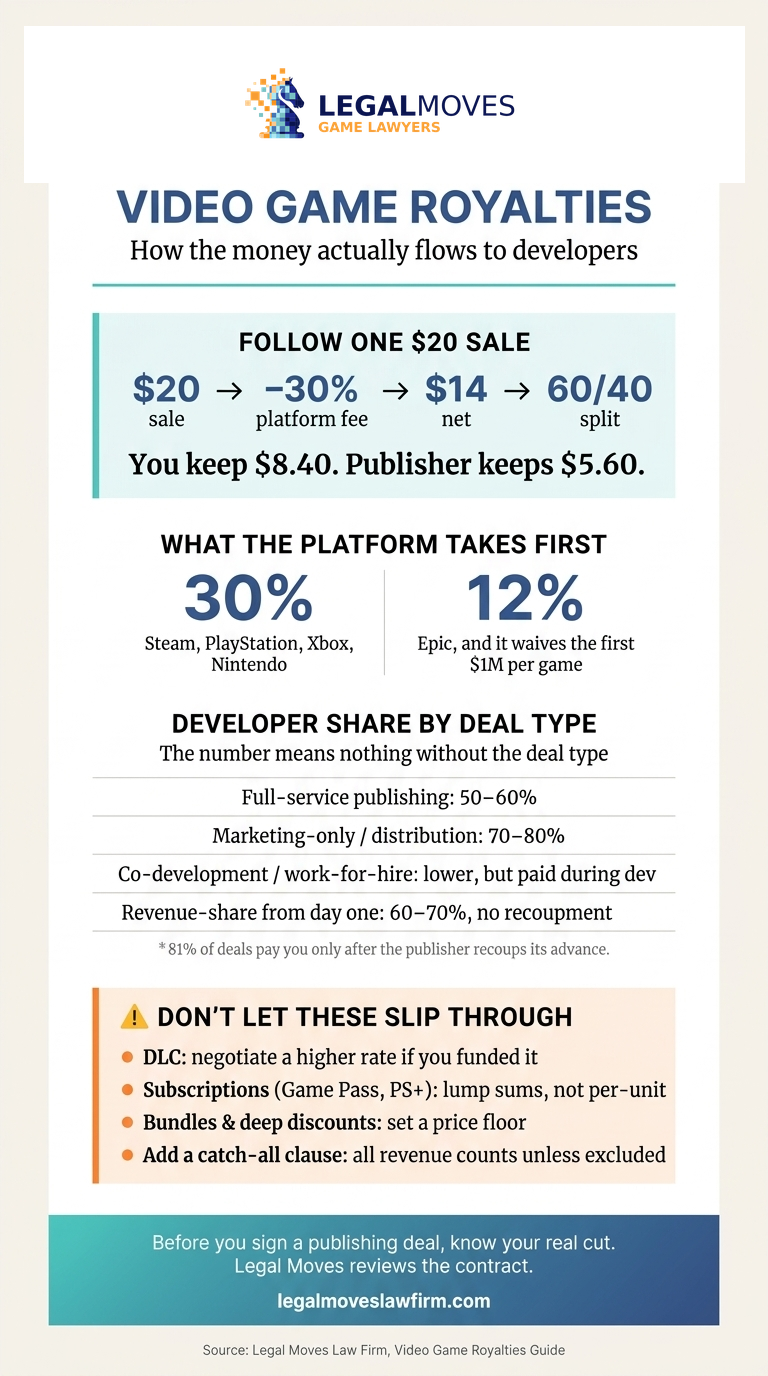
Follow the money through a typical deal. Your game sells a copy for $20 on Steam. Steam takes its 30% cut ($6). The remaining $14 is the “net revenue” base.
You and the publisher split that $14 according to your royalty rate. At a 60/40 split, you get $8.40 per copy. The publisher gets $5.60.
That 30% platform fee is standard across Steam, PlayStation, Xbox, and Nintendo. Epic takes 12% and waives the first $1M per app starting June 2025, which changes the math significantly for smaller titles (though it depends on what kind of sales numbers you make on that platform).
Your choice of platform directly affects how much net revenue exists to split. You can run your own numbers in the free royalty and recoupment calculator above, or on its own page if you want to bookmark it.
Game publishers usually fund development of the game (though it’s getting increasingly common to have “marketing only” deals, which aren’t great from what I’ve seen). The entire deal revolves around recouping that investment before the developer sees full royalty payments.
By contrast, in music, the label funds recording but the artist typically has ongoing revenue streams from touring and live performance. Game developers don’t have that fallback, which makes your contract terms even more critical.
The single most important definition in your contract is “net revenue.” At minimum, platform fees get deducted. That’s fair. But some publishers also deduct marketing costs, localization expenses, QA spending, and porting costs.
Every additional deduction shrinks the revenue pool you’re splitting. I’ve reviewed contracts where the deductions were so broad that “net revenue” was less than half of gross sales. They’re full of vague and open-ended wording, which allows the publisher to do some shady accounting by adding lots of deductions.
This fills their pockets first, and robs from your potential revenue share.
Fight to limit deductions to platform fees, or at minimum cap any additional deductions at a dollar amount you approve in advance.
Typical video game royalty rates and what affects them
There isn’t one average, because the advance changes everything. Voyer Law’s 2026 market report, built on 130+ publishing agreements dated 2017 to 2026, puts the developer’s share at 57.9% when there’s an advance and 67.9% when there isn’t. That tracks with what I see in my practice.
Averages hide important variation. Deal size matters enormously, and so does what the publisher brings to the table beyond money.
No-advance deals average 67.9% to the developer, and the lowest one in the sample was still 50%. Makes sense. If the publisher isn’t fronting cash, they shouldn’t take a large cut. Arguably it should be even higher to the developer.
Deals with an advance average 57.9%, but that average is doing a lot of hiding. The range in Voyer’s sample runs from 2.5% to 90%. A developer somewhere signed away 97.5% of their game’s revenue. Whatever “market standard” means, it doesn’t mean much at that spread.
Console-only deals, the kind that follow a successful PC launch, average 66%. That reflects reduced risk on a proven game plus the specialized work of console publishing.
The pattern is clear. Bigger advance equals smaller royalty percentage. The publisher takes more risk, so they want more upside.
In my experience, developers consistently overvalue the royalty percentage and undervalue the advance itself. A 70% split means nothing if the game never recoups.
Rami Ismail’s prioritization framework is worth remembering: prioritize upfront funding first, then your post-recoup split, then your pre-recoup split. Most games don’t earn back their advance. The upfront money may be all you ever see.
That’s the uncomfortable truth developers need to hear before obsessing over their royalty percentage. I’ve reviewed deals where developers negotiated an extra 5% on the split but left lots of advance money on the table. The math rarely favors that trade, given the hit-driven nature of our industry.
One notable exception is the Hooded Horse model. Publisher Tim Bender offers a flat 65/35 split from dollar one with no recoupment. Developer-friendly, transparent, and rare. Don’t walk into negotiations assuming every publisher will match it, but do use it as a benchmark for what a fair no-recoupment deal looks like.
(also beware the publisher that insists they are the fairest or most developer-friendly one around…)
Recoupment in game publishing: when developers actually get paid
Before you earn full royalties, the publisher recoups their investment. In Voyer’s 2026 sample, 94.7% of advances were recouped. Assume yours will be.
How recoupment works varies dramatically, and it determines when (or whether) you actually get paid.
There are two primary models.
Full-stop recoupment
Used in 37% of deals, where the publisher recoups in full before any revenue share reaches the developer. The developer gets $0 until the advance is paid back. Simple and harsh.
Concurrent recoupment
Used in the other 63%. The developer gets a small percentage during the recoupment period, and the rest of the developer’s share pays down the advance. Voyer’s data gives you a sense of the size: in advance deals that step the revenue share up over time, the opening rate averages 24% to the developer.
This keeps cash flowing to the developer during the recoup phase, even if it’s modest.
Consider this example using Rami Ismail’s math. Take a $200K project with a 70% publisher recoupment rate. The developer earns roughly $85K by the time the publisher has retained $200K in revenue.
That requires approximately $460K in total game revenue. At that revenue level, the platform (Steam, for example) has earned about $122K. More than the developer.
Read that again. The platform takes more than the developer on the developer’s own game.
The “developer share only” trap
This is the structure I flag hardest in contract reviews. Repa Davies has called recouping from the developer’s share only “grossly unfair,” and I agree.
Say you have a $500K advance with a 50/50 post-recoupment split, and the publisher recoups from the developer’s share only. The publisher needs to recover $500K, but only your 50% counts toward recoupment.
That means the game must generate $1M in net revenue before you see a single royalty dollar. Meanwhile, the publisher collects their 50% the entire time, pocketing $500K during recoupment.
Before signing, ask three questions: (1) Which recoupment model is it? (2) Recoup from whose share? (3) What costs are included in the recoupable amount?
The answers to these three questions will tell you more about your deal than the royalty percentage itself.
Deal types that change your royalty expectations
Comparing royalty rates without context is meaningless. A 50/50 split in one deal might be excellent. In another, it’s a ripoff.
Deal type determines which.
Full-service publishing
The publisher funds development, handles marketing, and manages distribution. Expect 50-60% developer share post-recoupment.
The publisher is taking significant financial risk. This is the most common structure.
Marketing-only or distribution deals
You self-fund development. The publisher handles marketing, PR, or storefront placement. You should expect 70-80% or more.
If a publisher offers 50/50 for a marketing-only deal, push back hard. They’re not earning that cut.
Also, be very aware of what they’re actually obligated to do here. Often, these deals have vague publisher responsibilities, no minimum spend (and very little oversight or visibility), and other unfavorable terms.
Just be wary - enter into these deals with your eyes wide open. Our guide to indie dev publishing agreement pitfalls covers the specific warning signs to look for before signing.
Co-development and work-for-hire hybrids
The publisher owns the IP. You build to spec. Royalties may be lower or nonexistent, but you get paid during development.
Guaranteed income versus long-term upside.
Revenue share from day one (no recoupment)
An emerging model where the developer gets paid from dollar one. Typically 60-70% developer share. No “recoupment” phase.
Hooded Horse reportedly operates this way. It’s gaining traction among smaller publishers but still the exception in the broader market.
You typically see this in the publishing-only (no dev funding) deals, in my experience.
My non-legal advice: deal type should dictate your royalty expectations. A good full-service deal with a low percentage may look worse than a marketing-only deal with a high percentage, but this seems to rarely be the case when viewed holistically.
Context matters more than the number itself.
Also critical: sequel clauses appear in 55.3% of agreements with an advance and 42.4% of agreements without one. Read yours closely, because there are two very different versions. In 60% of advance deals that have one, the publisher only gets the right to negotiate for the sequel. In the other 40%, they get the sequel. That distinction is worth more than any royalty point you’ll argue over, and it sometimes hides inside a right of first refusal. Make sure you understand how royalties apply to sequels, and negotiate separate terms if possible, before you sign the first deal.

DLC, subscriptions, and modern revenue streams in royalty agreements
Fortnite generated $2.4B in 2018 from in-app purchases alone. If your agreement doesn’t address how DLC and other in-game purchase revenue is split, you could leave significant money on the table.
Developer-funded DLC
If you fund DLC development with no publisher contribution, negotiate a higher royalty rate on that content. Many default agreements apply the base game royalty rate to all DLC automatically.
That’s unfair when the publisher didn’t fund the additional content.
Subscription services
Game Pass, PS+, and Apple Arcade pay lump sums, not per-unit royalties. Your agreement must specify how subscription revenue gets allocated to your title.
This isn’t hypothetical. Tangent Games sued Sony for allegedly failing to pay royalties on PS+ subscriber distribution. If “units sold” is the only trigger for royalties in your contract, subscription placement might generate zero payments.
Make sure your gross revenue definition captures all of the subscription, streaming, exclusivity deals, and similar services and funding models.
Bundles and deep discounts
How are royalties calculated when your game is 90% off during a Steam sale? What about when it’s bundled with 5 other games of varying prices?
Specify a minimum price floor or require separate treatment for bundle deals. Otherwise, you could earn pennies per unit on a game that thousands of people are buying.
The catch-all clause
I advise every developer to include language stating that any revenue generated from the game, regardless of source or distribution method, is included in the royalty calculation unless explicitly excluded.
New monetization models emerge constantly. Without this clause, revenue from a distribution method that didn’t exist when you signed could fall outside your royalty calculation entirely. Cloud gaming and AI-generated content monetization are two areas where this is already becoming relevant.
So you define it broadly at first (“all revenue received by publisher from the exploitation of the Game and its associated intellectual property”) and then include specifics like premium unit sales, in-game purchases, ad revenue, subscription/streaming revenue, merchandise, etc. as examples (but not as limitations on the broad wording).
Royalty payment timing and audit rights
Getting the right royalty rate means nothing if you can’t verify the numbers or get paid on time.
Payment timing
Quarterly payments are the industry standard. They arrive 30-45 days after each quarter ends. A sale in January might not generate a royalty payment until mid-May. That’s up to four months of delay.
Push for monthly reporting even if payment stays quarterly. You want visibility into sales data in near real-time, not a surprise report every 90 days. Monthly reports let you spot discrepancies early and plan your studio’s finances around actual revenue data.
Even better, get them to agree to real-time access to sales dashboards or at least providing the reporting direct from the platforms when available. Then you see the real unvarnished numbers.
Audit rights are non-negotiable
Audit provisions are common but not universal, and the gap runs the opposite direction from what you’d expect. Voyer’s 2026 report found them in 88.4% of deals with an advance and 71.4% of console-only deals, but in only 66.7% of deals without an advance. So a third of self-funded developers, the ones who kept the strongest revenue share, have no contractual way to check the publisher’s math. If yours doesn’t include audit rights, that’s a red flag, and if you’re signing a no-advance deal, assume you’ll have to ask.
Audits matter because of where the money goes missing.
It’s almost never the unit count. Publishers are not, in my experience, sitting there deleting sales. What they do is interpret the agreement in their own favor, one deduction at a time, and the gap between their reading of “net proceeds” and yours compounds quarter after quarter until it’s real money. A royalty statement can be arithmetically perfect and still be wrong by six figures.
That’s why the audit clause matters more than most developers think. It isn’t there to catch fraud. It’s there to make someone show their work on the definitions, which is the only way you’ll ever find out that “marketing costs” quietly included the publisher’s staff salaries.
You will see a specific underreporting percentage quoted around the licensing world. I’ve gone looking for its source more than once and there isn’t one, so you won’t find it here.
Good audit provisions include four elements:
- Right to audit at least once per year. I’ve seen publishers try to limit audits to once over the entire contract term. Unacceptable.
- Publisher pays audit costs if the discrepancy exceeds 5-10%. This incentivizes accurate reporting.
- Access to underlying records, not publisher-generated summaries. You need the raw data.
- Audit window covering the last 2-3 years. Anything shorter limits your ability to catch long-term patterns.
- No “deemed accepted” language. We don’t want to be held to incorrect royalty statements just because a certain amount of time has passed (usually 12 months, way too short).
If a publisher won’t agree to reasonable audit rights, ask yourself what they’re hiding.
Royalty statements should itemize revenue by platform, territory, and product so you can cross-reference against your own data. Vague, lump-sum reporting is a warning sign.
Consider asking to see a royalty report template that they use in their publishing deals.

Negotiating better royalty terms: what to push back on
Developers have more leverage than they think. These are the clauses I push back on in every contract I review.
Net revenue definition
The most important definition in the entire contract. Push to limit deductions to platform fees only.
If the publisher wants to deduct marketing costs, cap them at a specific dollar amount that you approve in advance. I’ve seen “net revenue” definitions that deduct so many costs the developer’s 60% share is effectively 30%.
Recoupment structure
Push for concurrent recoupment over full-stop, even if the amount is much less (5-15%) prior to recoup. Push to recoup from gross/net revenue (both parties’ shares), not the developer’s share only.
The difference between these structures can be hundreds of thousands of dollars.
Tiered royalty rates after recoupment
Escalating developer percentages at revenue milestones reward success. Example: 60/40 up to $1M in net revenue, 70/30 from $1M to $5M, 80/20 above $5M. This gives the publisher a fair return while ensuring the developer benefits proportionally from a hit.
Here’s the part most developers miss. You probably already have tiers. Voyer’s 2026 data found stepped revenue shares in 80.3% of agreements with an advance, and the step is steep: the opening stage averages 24% to the developer, the stage after it averages 60.3%. Your contract will call these stages “tranches.” So the real negotiation usually isn’t whether you get a step-up. It’s where the step-up triggers and how long you sit at the opening rate. Ask what specifically moves you to the higher stage, and whether anything other than recoupment can move you there.
Another option is including specific bonus payments for sales milestones, metacritic/other scores, or awards wins/nominations.
IP ownership
One thing is clear: never accept a 50/50 IP split or other shared ownership. It’s one of the most costly contract mistakes developers make. In North American law, each co-owner of IP gets 100% exploitation rights.
The publisher can license, sequel, merchandise, or adapt your game without answering to you or getting your approval. Either you own the IP or they do. Split ownership is a trap.
Red flags to watch for
Cross-collateralization appears in multi-game or multi-platform deals. The publisher offsets losses from one game/version against royalties earned by another. Your hit game subsidizes their flop. Avoid this.
Transfer-on-breach clauses have become rare, but rare is not zero. Voyer’s 2026 report found IP transferring to the publisher on developer breach in 7% of agreements, roughly one in fourteen. The publisher claims IP rights if the developer “breaches” the contract.
The definition of breach is often vague and publisher-friendly. A missed milestone could cost you your IP.
Takeover rights are also something commonly added by publishers. They may not “own” your IP, but they can terminate and take over development, essentially locking you out.
Every term is negotiable. Our contract negotiation guide for game developers covers the full process from preparation to close. “This is our standard deal” is publisher language for “this is what we offer developers who don’t push back.”
What to do if a publisher doesn’t pay your royalties
If your publisher isn’t paying royalties, you have options. Don’t assume you’re stuck because you signed a contract.
Step 1: document everything
Gather your agreement, royalty statements, all correspondence, and your own platform data. Tools like SteamDB and third-party estimates can provide independent benchmarks. If the publisher reports 10,000 units and your data suggests 50,000, that’s the basis of a claim.
Step 2: send a formal written demand
Reference specific contract provisions. Cite the royalty rate, payment schedule, and audit rights. Put it in writing. This creates a paper trail and puts the publisher on notice.
Step 3: exercise your audit rights
Trigger the audit clause immediately. An independent audit often reveals the scope of the problem, and it frequently reveals it on the first look rather than after years of suspicion. If you have the right, use it. An audit right you never exercise is a clause, not a protection.
Step 4: consult a gaming attorney
Many litigation attorneys take royalty disputes on contingency, typically around 40% of the recovery. This model makes legal action accessible to indie developers who can’t afford upfront legal fees.
Real disputes happen at every level. West and Zampella, the creators of Call of Duty, sued Activision over $1B alleging they were fired to avoid royalty payments. Tangent Games sued Sony over unpaid royalties tied to PS+ distribution.
Both cases demonstrate that publishers of all sizes face accountability.
The threat of litigation is often enough. Discovery exposes accounting. Most publishers prefer writing a check to opening their books.
If you think you’re owed royalties, set up a consultation with a game lawyer sooner rather than later.
Mobile games, bankruptcy, and taxes
Do mobile game royalties work differently than PC/console?
Mobile deals often revolve around revenue share with the platform (Apple and Google take 30%, dropping to 15% for small developers). Publisher deals on mobile frequently involve user acquisition spending as a major deduction from net revenue, which can dramatically reduce the royalty pool compared to a premium PC/console release. They also often have an initial “testing” period prior to “full” publication, so you may not have an actual publishing deal in the first place.
What happens to royalties if my publisher goes bankrupt?
Your royalties become a claim in bankruptcy proceedings. You’ll likely be an unsecured creditor, behind secured lenders in priority. This is why IP reversion clauses are essential. If the publisher can’t operate, you need the rights to your game back so you can self-publish or find a new partner.
Are royalties taxed differently than regular income?
In the US, royalty income is generally reported as ordinary income for tax purposes. The structure of your deal matters. If you’re set up as an LLC or corporation, the tax treatment differs from individual royalty income. Consult a tax professional familiar with entertainment or gaming income.
Can I negotiate royalties on merchandise or media adaptations?
Yes, and you should. If the publisher controls merchandising or media rights, your agreement should specify a royalty rate for those revenue streams. Game IP adaptations are increasingly valuable. Don’t let ancillary rights default to the publisher without compensation.
I am also skeptical of even granting these, if the publisher has never actually exploited them in the past.
Want to handle this yourself, without hiring a lawyer?
Speedrun Legal is a 44-lesson course covering contracts, trademarks, copyright, LLCs, and publishing deals — built for indie devs on a budget. Includes a Contract Generator and AI publishing-deal review tool.
FAQ
What is a typical video game royalty rate?
It depends on whether there’s an advance. Voyer Law’s 2026 market report, built on 130+ agreements dated 2017 to 2026, puts deals with an advance at 57.9% to the developer on average. Deals without an advance average 67.9%. Console-only deals average 66%. The observed range runs from 2.5% to 90%, so your rate depends heavily on advance size, deal type, and what the publisher contributes beyond funding.
How does recoupment work in game publishing?
The publisher keeps most or all revenue until they recover their investment. In Voyer’s 2026 sample, 94.7% of advances were recouped. In 37% of deals the publisher recouped in full before the developer received anything, which is full-stop recoupment. The other 63% used concurrent recoupment, paying the developer a slice while the remainder pays down the advance.
What is net revenue in a game publishing agreement?
Net revenue is gross sales minus agreed-upon deductions. At minimum, platform fees (typically 30%) are deducted. Some agreements also deduct marketing, localization, and QA costs. This definition is one of the most important clauses in your contract because it determines the actual pool of money being split between you and the publisher.
How long does it take to receive royalty payments?
Quarterly payments are standard, arriving 30-45 days after each quarter ends. A sale in January might not generate a royalty payment until mid-May. Push for monthly reporting even if payments remain quarterly. Monthly visibility into sales data helps you catch discrepancies early and plan your studio’s finances.
Can a game developer audit a publisher’s royalty payments?
Usually, but don’t assume. Audit rights appeared in 88.4% of advance deals and 71.4% of console-only deals in Voyer’s 2026 sample, but in only 66.7% of no-advance deals. Good audit clauses require the publisher to pay audit costs if discrepancies exceed 5-10%. If your agreement lacks audit rights, negotiate to add them before signing.
Should I hire a lawyer to review a game publishing agreement?
Yes (says the game lawyer). A game attorney identifies unfavorable recoupment structures, missing audit rights, IP transfer clauses, and cross-collateralization provisions that most developers miss. The cost of legal review is small compared to the revenue at stake over a 5-7 year publishing term. Set up a consultation with a game lawyer here.