
Licensing deals in games should be straightforward. Creator makes something. Licensee pays for the right to use it. Both make money. But I’ve reviewed dozens of licensing agreements where the financial mechanics are so poorly defined that disputes are almost inevitable.
Most creators focus on the headline number, the royalty percentage. They miss the math that determines whether they actually get paid.
Below is a breakdown of the financial structures you’ll encounter, and what they actually mean before you sign.
Upfront payments: advances and minimum guarantees aren’t the same thing
When someone licenses your IP or your design, they usually pay upfront. But that payment comes in two different forms, and they work completely differently.
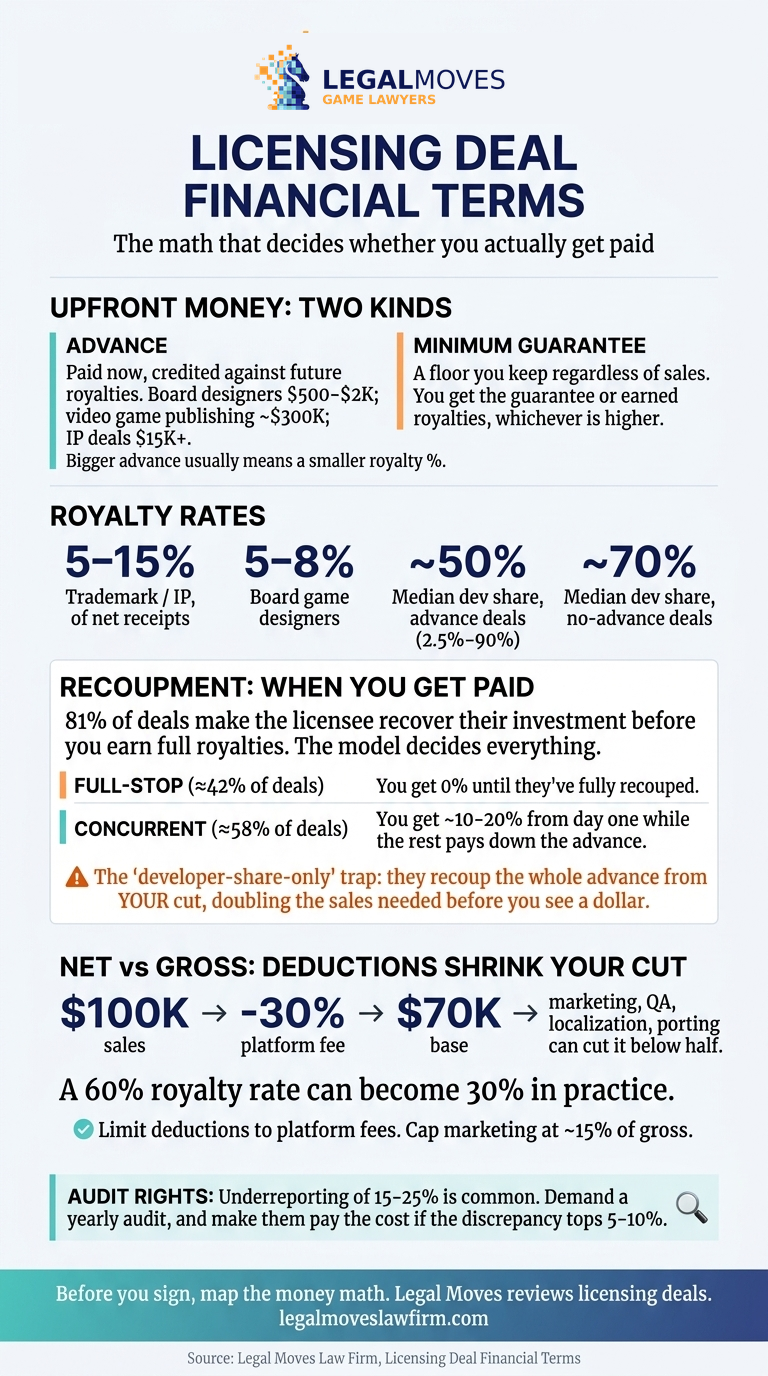
An advance is money credited against future royalties. You receive it immediately, but it reduces what you earn later. In board game designer agreements, advances typically range from $500 to $2,000 for newer designers, though established designers command more. Video game publishing advances run a median of about $270,000, though the average is closer to $600,000 because a handful of very large deals drag it upward. IP licensing deals (like a movie-themed board game) often start at $15,000 or higher.
A minimum guarantee is fundamentally different. It’s a floor payment you receive regardless of sales performance. If the game generates $50K in royalties or $500K, the licensor receives the guaranteed minimum or the earned royalties, whichever is higher. These are most common in foreign language licensing and high-value trademark deals, where the original publisher wants certainty.
The financial tradeoff is critical: larger advances usually mean lower royalty percentages. The licensee is assuming more risk upfront, so they protect that investment by taking a smaller cut on the back end.

Royalty rates: context matters more than the number
This is where confusion starts. The headline percentage means almost nothing without context.
For trademark and IP licensing in entertainment and gaming, expect 5-15% of net receipts. Exclusive licenses command higher rates than non-exclusive. Board game designers typically earn 5-8% of wholesale price or net sales, with established designers pushing higher. In video game publishing, the developer’s revenue share on advance-based deals averages 57.9%, with remarkable variation from as low as 2.5% to as high as 90%. No-advance deals see developers commanding 67.9% on average.
These figures reflect market data from recent publishing agreements; specifics vary based on industry conditions, company track record, and negotiating leverage.
The more upfront funding the publisher provides, the smaller your percentage becomes. This is why focusing on the royalty rate alone is a trap. A 70% rate on a deal that never recoups your advance means zero dollars. A 50% rate on a hit game generates vastly more real revenue.
Rethink your priorities: upfront funding first, then your post-recoupment split, then your pre-recoupment terms. Most games don’t earn back their advance. The upfront money may be all you ever see.
Recoupment mechanics: when (or if) you actually get paid
Nearly every advance gets recouped. In Voyer Law’s 2026 review of 130+ video game publishing agreements, 94.7% were. Before you earn full royalties, the licensee needs to recover their investment. How that works determines whether you see revenue or spend years waiting.
Full-stop recoupment gives you nothing until they’ve fully recouped. Used in 37% of deals. Simple and harsh.
Concurrent recoupment is more developer-friendly and covers the other 63%. You receive roughly 10-20% of your royalty share from day one. The remaining 80% pays down their advance. At least cash flows to you during the recoup period.
But watch for the “developer share only” trap. The licensee recoups their entire advance solely from your portion of revenue, not from total net revenue. This effectively doubles the sales required before you see a check. A $500K advance with a 50/50 split, recouped from your share only, means the game must generate $1M in net revenue before you earn a single royalty dollar. Avoid this structure entirely.
Ask three questions before signing: (1) Which recoupment model is it? (2) Recoup from whose share? (3) What costs are included in the recoupable amount? The answers determine your deal’s value far more than the royalty percentage.

Net revenue vs. gross revenue: how deductions swallow your money
This is the most important definition in your entire contract.
Your game sells $100K on Steam. Platform fees (30% standard across Steam, PlayStation, Xbox, and Nintendo) reduce that to $70K. That $70K is your potential royalty base.
But licensees often try to deduct more: marketing costs, localization, QA, porting. Without limits, “net revenue” becomes whatever’s left after the licensee subtracts everything they spent on your game and their overhead.
I’ve reviewed contracts where deductions were so broad that “net revenue” was less than half of gross sales. That 60% royalty rate becomes 30% in practice.
The rule is non-negotiable: limit deductions to platform fees only, or at minimum cap additional deductions at a specific dollar amount you approve in advance. For marketing specifically, a standard market cap is around 15% of gross revenue. Without this, marketing budgets can consume your entire royalty pool.
Financial transparency and audit rights
I’ve seen audits that uncovered millions in unpaid royalties, and the discrepancies almost never come from miscounting units. They come from how the licensee interpreted “net proceeds” in the agreement. A royalty statement can be arithmetically flawless and still be wrong by a very large number, because the error is upstream of the arithmetic, sitting in a definition both sides signed and only one side read carefully.
Audit rights are common but not standard, and the split runs opposite to what most people assume. In Voyer Law’s 2026 video game sample they appeared in 88.4% of deals with an advance and 66.7% of deals without one. Tabletop is tighter still: the Tabletop Game Designers Association’s 2026 contract analysis found that “one third of publishers do not allow designers to audit their books.” Standard audit terms should allow you to audit at least once per year. The gold standard requires the licensee to pay audit costs if the discrepancy exceeds 5-10%. This incentivizes accurate reporting.
If your agreement lacks audit rights, that’s a red flag. Ask yourself what they’re hiding.
Critical risks in licensing structures
Three structural problems appear regularly and can destroy your deal economics.
Cross-collateralization in multi-game or multi-platform deals lets the licensee offset losses from one product against royalties from another. Your successful game subsidizes their flop. Avoid this if possible.
Naked licensing matters specifically to trademark owners. If you license your mark but fail to enforce quality control, courts can rule the trademark abandoned. You lose the entire brand. Every trademark licensing agreement needs quality control provisions, and you must actually enforce them.
Modern revenue streams like DLC, Game Pass, subscriptions, and bundles aren’t captured by traditional “per unit” royalty definitions. Ensure your agreement explicitly covers these lump-sum and streaming distribution models. Cloud gaming and new monetization methods will keep emerging, so include broad language capturing all future revenue sources.
Want to handle this yourself, without hiring a lawyer?
Speedrun Legal is a 44-lesson course covering contracts, trademarks, copyright, LLCs, and publishing deals — built for indie devs on a budget. Includes a Contract Generator and AI publishing-deal review tool.
What you should do
Before signing any licensing agreement, take these steps to protect yourself:
- Map the money math. Calculate what the advance means in real terms. How many copies do you need to sell to recoup it? What’s the effective royalty percentage after deductions?
- Narrow “net revenue” aggressively. Limit deductions to platform fees, or cap additional deductions at a specific dollar amount. Get marketing deductions capped at 15% of gross.
- Choose concurrent recoupment. Insist it recoups from total net revenue, not your share only. At minimum, push for 10-20% of your royalty flowing to you from day one.
- Add audit rights. Include the right to audit at least yearly. Require the licensee to pay audit costs if discrepancies exceed 5-10%.
- Define modern revenue streams. Spell out how DLC, subscriptions, bundles, and any other non-unit-sale models are royalty-eligible.
- Get monthly reporting. Even if payments stay quarterly, push for monthly sales visibility so you can spot issues early.
- Require quality control. If you’re licensing your IP, include quality control provisions and actually enforce them. Otherwise your trademark could be lost to abandonment.
Every term is negotiable. Licensees say “this is our standard deal” as shorthand for “this is what we offer creators who don’t push back.”
Questions about your specific licensing deal? Get in touch and we can walk through the financial terms together.