
You signed up to make games, not to read a forty-page publishing contract at 11pm, wondering which clause is the one that ruins you.
Then it lands in your inbox anyway. Or a contractor goes quiet and you realize you never got the art assigned to you. Or a near-identical version of your game shows up on Steam, or a studio you’ve never heard of files for the name you’ve been building.
Search “video game lawyer” and half the results are about Phoenix Wright. This is for the other half of you, the ones with an actual legal problem and a real studio to protect.
I’ll answer the three things every other page dodges: what a video game lawyer actually does, when you genuinely need one versus when a template is fine, and what it costs. With real numbers, because nobody else will give them to you.
This is general education about US law, not legal advice for your specific situation.
What a video game lawyer actually does
“We handle IP and contracts” tells you nothing (most probably don’t even know what “IP” means). So here is the real day-to-day, in the situations that actually send a studio looking for help.
Protecting your name and your work. That means clearing and filing a trademark for your game and studio name before someone else does, and registering copyright in your assets. A board game company launching on Kickstarter under a name nobody cleared is one cease-and-desist away from a rebrand mid-campaign. A good trademark filing for your game gets ahead of that, and it helps to know what a trademark attorney costs before you start.
Contracts, the ones you sign constantly. NDAs, contractor agreements, music and art licenses, your EULA, terms of service, privacy policy. Licensing a real song for your soundtrack actually needs two separate licenses, one for the composition and one for the recording, and missing either is infringement. These are the contracts every game developer needs.
Reading the publishing deal before you sign it. This is where the money hides. A lawyer is looking at recoupment, audit rights, and cross-collateralization, not the headline royalty split.
Take a $500,000 advance and a 50/50 split where the publisher recoups from your share. Your game has to clear a million dollars in net revenue before you see a single royalty dollar. The structure, not the percentage, is the thing. Knowing how to negotiate a publishing deal starts with reading that clause correctly.
Making sure you own your own game. Pay a freelancer for code and, under US copyright law, the contractor often still owns it unless your contract has the right assignment language. Software is a “literary work,” not one of the nine categories that “work for hire” automatically covers. I wrote a whole piece on why your contractor might still own the art you paid for.
Enforcement when someone copies you. Cease-and-desist letters, DMCA takedowns, and responses when a bigger company comes at you. When the fan game Fighting is Magic got a cease-and-desist from Hasbro, the team rebuilt it into the original Them’s Fightin’ Herds. A lawyer tells you when a threat has teeth and when it’s just bluster.
The through-line: a game lawyer’s job is to catch the expensive thing while it’s still cheap to fix.

When you actually need one (and when a template is fine)
A games lawyer telling you that you don’t always need a lawyer should hopefully earn a little trust. So here it is: you don’t.
For the routine, low-stakes 80 percent, a solid template is probably fine. An early NDA, a standard contractor agreement on a small commission, your first formation paperwork. This is exactly the lane Speedrun Legal was built for, a course with a contract generator that produces the documents you’d otherwise reinvent every time you hire someone. DIY is cheap and fast. It is also duct tape, and you should know when you’ve hit the part that duct tape doesn’t hold.
You’ve hit that part when any of these is true:
- You’re signing a publishing or distribution deal. Always. The whole point is the part you can’t see.
- You’re bringing on a co-founder. If two of you build a game and never assign your contributions to the company, you each own half and either one can block a sale or a license. Fix it on day one, not during diligence.
- You’re hiring a freelancer for anything that matters to the core of your game. Art, code, music, writing. No written IP assignment means a gap in what you own.
- You got, or need to send, a cease-and-desist. Guessing here is expensive in both directions.
- You’re launching a Kickstarter. Backers are funding a thing you need to legally own and be able to ship.
- You found a trademark conflict, or you’re close enough to launch that you can’t afford one.
- There’s a contract in front of you that you cannot fully read. That feeling is information.
The math is simple. The cost of getting it right up front is small next to the cost of unwinding it later, when your leverage is gone and the problem is already load-bearing.
If a deal, a dispute, or shared IP is involved, that’s usually the line where your ability to DIY things stops.
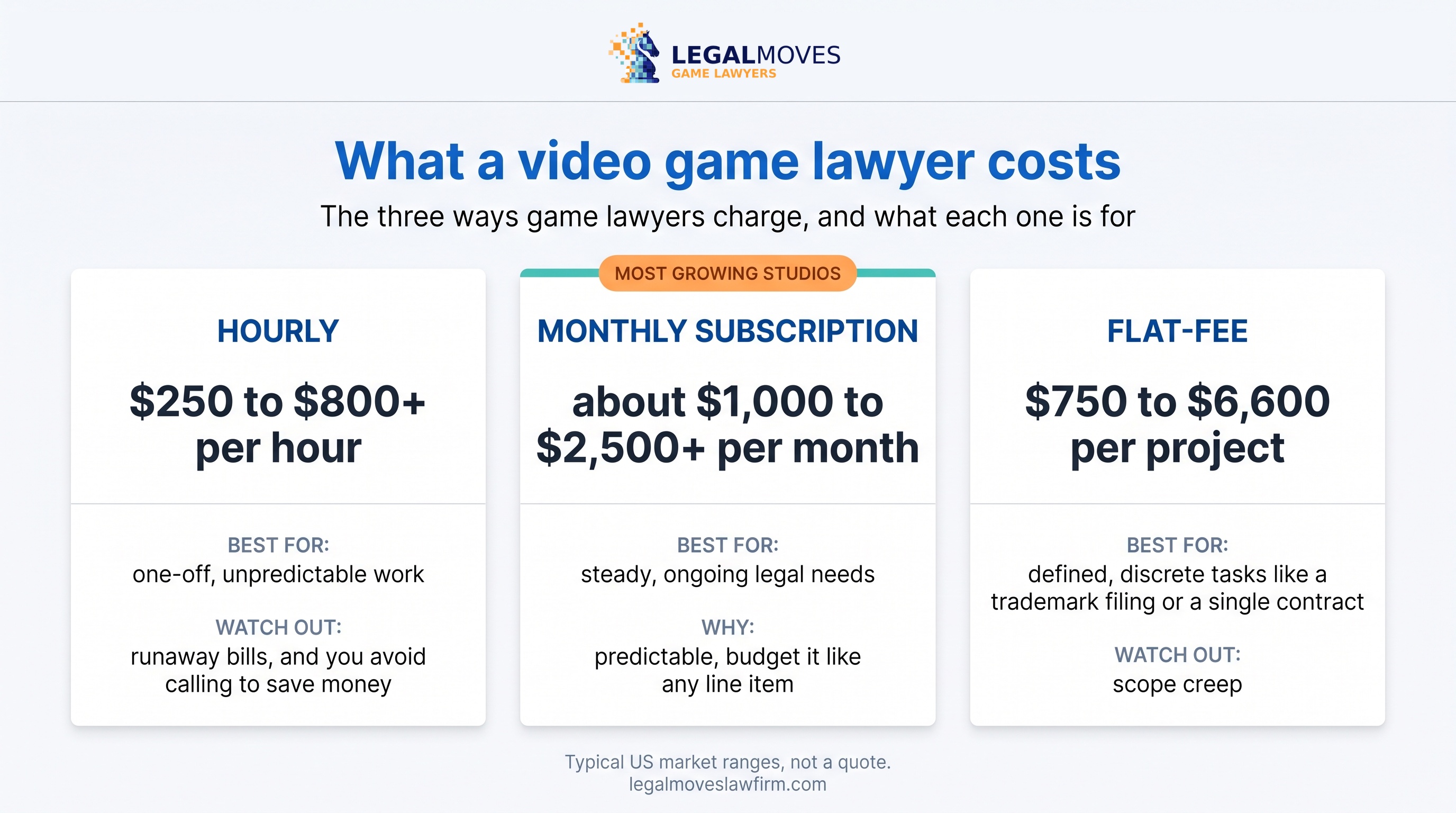
What it costs: hourly, flat-fee, and monthly explained
Let’s talk money, since that’s the question that probably brought you here.
One common question is about “retainers” for legal services. For example: what does a $10,000 retainer mean?
It does not mean the lawyer pockets ten grand. A retainer is a deposit that sits in a trust account, and the attorney bills against it as they work. At $500 an hour, that’s about 20 hours. Anything left over when the work is done comes back to you (here’s how retainers work).
There are three ways a game lawyer charges, and the right one depends entirely on what you need.
Hourly
Game lawyers generally run anywhere from $250 to upwards of $800 an hour, depending on the firm, the city, and how complex the work is. For reference, the average US lawyer across all practice areas bills about $349 an hour, so a seasoned game specialist tends to sit toward the upper end, and you’re paying for someone who already speaks games.
Hourly is right for genuinely unpredictable work, like a one-off review or something that could go five directions. The hidden cost is subtler: when every email and call is metered, studios stop calling to save money, and that’s exactly when problems quietly grow.
Flat-fee per project
For defined work, a fixed price beats the meter. You know the number before you start.
Rough ranges: a trademark registration runs $1,200 to $2,500 plus the USPTO filing fee of $350 per class. A simple contract is $750 to $1,250. Some firms bundle a studio startup package, formation plus trademark plus core contracts, for somewhere around $3,400 to $6,600.
Flat fees have become the norm, not the exception. As of 2024, most law firms bill flat fees at least some of the time. The catch is scope creep: if the job grows past what was quoted, the fee does too.
Monthly subscription
Instead of paying per task, you pay a flat monthly fee for ongoing access to your lawyer. The model has a name in the legal world, outside general counsel, and the American Bar Association now treats it as a mainstream alternative to hourly billing.
Entry tiers for a small studio commonly land around $1,000 to $2,500 a month. Compare that to a full-time in-house general counsel, who runs $400,000 to $600,000 a year fully loaded before reviewing a single contract. The trade-off is the commitment: you pay in slow months too. But you also stop flinching every time you have a question.
Here’s how the three stack up:
| Hourly | Flat-fee | Monthly subscription | |
|---|---|---|---|
| Best for | One-off, unpredictable work | Defined, discrete tasks | Steady, ongoing legal needs |
| Typical cost | $250 to $800+/hr | $750 to $6,600 per project | ~$1,000 to $2,500+/mo |
| Predictable? | No | Yes, per project | Yes, monthly |
| Main risk | Runaway bill, under-asking | Scope creep | Paying in quiet months |
Note that these are typical market ranges, not a quote. Your number depends on your deal and your studio.
Why many growing studios end up on a monthly plan
Once you’re signing deals and shipping on a real schedule, the question stops being “what does this one contract cost” and becomes “how do I stop legal from being the thing I keep avoiding.” A monthly plan exists to answer exactly that.
You get a game lawyer on call for one predictable price, budgeted like any other line item. No “let me send you a quote” every time something lands in your inbox, which is the whole reason studios put legal off until it’s a crisis.
This is the model we run at Legal Moves, so I’ll just show you ours. Three tiers, and most studios land in the middle:
- Studio, $1,000/mo for studios with steady contract flow.
- Publisher, $2,250/mo for studios signing deals and building a portfolio. This is the one most pick.
- Franchise, $4,000/mo for publishers running a real slate.
It starts with a $500 Studio Legal Audit that gets credited to your first month, so the review pays for itself. There’s a free 20-minute fit call first, because a subscription is the wrong move for plenty of studios and I’d rather tell you that up front. And there’s a simple guarantee: your legal house is in order, with a solid plan moving forward, within 30 days or your first month is free. You can see the tiers and book the fit call here.
One honest disqualifier. If you’re a pre-revenue solo dev doing your first LLC and copyright filing, you are not ready for this, and I’d be taking your money. Start with Speedrun Legal, handle the routine stuff yourself, and come back when you’ve outgrown the templates.
Specialist vs generalist: why “games and nothing else” is cheaper
The specialist at $600 an hour is often cheaper than the generalist at $300. That sounds backwards until you watch the meter.
The generalist bills you while they learn. They’re Googling recoupment, figuring out what cross-collateralization means, reading up on platform terms of service and the nine-category work-for-hire rule, on your dime. The specialist already knows all of it and spends the time finding the clause that costs you money.
The premium buys speed, judgment, and experience, and it pays for itself fast. The cost of a careful review is small against the revenue at stake over a 5-to-7-year publishing term. And it’s not theoretical. Voyer Law’s 2026 report on 130+ publishing agreements found that four out of five advance deals pay the developer a low rate at first and a much higher one after a step-up, averaging 24 percent and 60.3 percent. Whether your contract’s step-up triggers at a number you’ll actually hit is worth more than every other clause combined, and it’s exactly the kind of thing someone learning on your dime reads right past.
So when you’re interviewing a lawyer, ask:
- Do you have actual game industry clients, or just general “entertainment”?
- Have you reviewed game publishing agreements before?
- Do you handle both trademark and copyright?
- Can you quote a flat fee for defined work, or is everything hourly?
- Do you offer a monthly option if I need regular support?
- For board game companies: do you know manufacturing and fulfillment agreements, foreign language licensing, Kickstarter terms, and mini sculpt and art agreements?
A generalist is the right call for your office lease. Your publishing deal is not the place to let someone learn on the job.

Frequently asked questions
How much does it cost to hire a video game lawyer?
Game lawyers bill roughly $250 to upwards of $800 an hour, depending on the firm, the location, and how complex the work is. A lot of work is flat-fee instead: a trademark filing runs about $1,200 to $2,500 plus the USPTO fee, and a simple contract $750 to $1,250. Monthly subscriptions for ongoing support typically start around $1,000 to $2,500. See the cost section above for the full breakdown.
What does a $10,000 retainer mean?
It is not money the lawyer keeps. A retainer is a deposit placed in a trust account, and the attorney bills against it at their hourly rate as they work. At $500 an hour, a $10,000 retainer covers about 20 hours of time, a realistic range for reviewing and negotiating a publishing deal. Whatever is left when the work finishes is refunded to you.
Do I need a video game lawyer licensed in my own state?
Usually not. Trademark and copyright are federal, the work is very specialized, so an attorney licensed in any US state can probably do that work for a studio located anywhere. For litigation, actually going to court, a lawyer admitted in that specific state is required. That’s why a specialist game firm can serve studios nationwide.
When should an indie developer hire a lawyer instead of using a template?
Templates are fine for early, low-stakes work like a basic NDA. Hire a lawyer the moment real money or shared IP enters the picture: signing a publishing or distribution deal, bringing on a co-founder, hiring a serious freelancer, getting a cease-and-desist, launching a Kickstarter, or registering a trademark. The cost of getting it right up front is small next to fixing it later.
What is an outside general counsel or legal subscription?
It’s a flat monthly fee for an on-call game lawyer instead of per-hour billing. The attorney gets embedded in your business and learns your IP and deal history, and you stop hesitating to ask questions because the meter isn’t running. It fits studios with steady legal needs, and it usually costs a fraction of a full-time in-house lawyer, who runs $400,000 or more a year.
Does my studio own code a contractor wrote without a contract?
Probably not. US copyright law only treats contractor work as “work made for hire” in nine specific categories, and software code is not one of them. Without a written IP assignment, the contractor who wrote the code owns it, which can block a publishing deal or an acquisition. A lawyer can usually fix this with a retroactive assignment. See why your contractor might still own the art for the full explanation.
This is general education about US law, not legal advice for your specific situation. If you want to know which lane your studio is in, the free fit call is a no-obligation place to start.