The question I hear most from board game designers is some version of “how do I patent a board game so nobody can rip it off?”
Here is the honest answer: you probably can’t, and you probably shouldn’t try.
That sounds harsh. It isn’t. Because you absolutely can protect your game. You just protect it with the right tool, and for most designers that tool is not a patent.
I’m a game IP and contract lawyer, but not a patent attorney, so I’ll keep the patent mechanics light and point you to the people who file them. But I can tell you exactly which kind of protection maps to what you’re actually afraid of losing.
Let’s sort it out.
Quick facts: protecting a board game
- Can you patent the game idea? No. Ideas and standard mechanics are not patentable.
- What can be patented? A genuinely novel, non-obvious component or method of play.
- Patent cost: $5,000 to $15,000+ for a utility patent, 18 months to 3 years to grant.
- Copyright covers: Your rulebook text, artwork, board graphics, and card illustrations.
- Copyright does NOT cover: The rules, mechanics, or method of play.
- Trademark covers: Your game’s name, logo, and distinctive packaging.
- Cheapest real protection: Copyright registration ($65 filing fee) plus a trademark ($350 filing fee) - doesn’t include legal fees.
- What most designers should do: Copyright the art and text, trademark the name, skip the patent.
Key definitions
Utility patent: Protects how an invention works, including a novel method or mechanism. In games, this is the rare patent that could cover a brand-new way of playing. Lasts 20 years.
Design patent: Protects only the ornamental look of an object, like a uniquely shaped board or game piece. It does not cover function. Lasts 15 years.
Copyright: Protects original creative expression once it is fixed in a tangible form, like your written rulebook and your box art. It does not protect the underlying rules.
Trademark: Protects the brand identifiers that tell buyers where a game comes from, like the name and logo. Can last forever with continued use.
Can you patent a board game? The honest answer
Yes, technically. Almost certainly not the way you’re picturing.
You cannot patent a game idea, and you cannot patent a standard mechanic. Roll-and-move, worker placement, area control, deck-building, set collection: those are all fair game for anyone to use. The “idea” of a game gets no protection at all.
A utility patent has to clear four bars. It must be patentable subject matter, useful, novel, and non-obvious. Novel means nobody has done it before. Non-obvious means it isn’t an easy tweak on something that already exists.
Most board games are a clever new combination of mechanics that already exist. That is great design. It is also exactly what fails the novelty and non-obviousness tests.
So what can you patent? A genuinely new physical component, a new apparatus, or a truly original method of play that nobody has done before.
The cleanest real example is Magic: The Gathering. Richard Garfield patented the core method behind it, including the now-famous move of rotating a card to show its resource is spent, which players call “tapping.” That patent (US 5,662,332) was granted in 1997 and assigned to Wizards of the Coast.
Even that one was controversial. Critics argued it choked off competing card games for years, and it finally expired in 2014.
The point stands: it took an inventor building a genuinely new category of game to earn a defensible patent.
If your game is a fresh remix of mechanics players already know, a patent is not your tool. Keep reading, because something here is.
Patent vs. copyright vs. trademark: what each one protects
Stop asking “which one do I need” and start asking “what am I trying to protect.” The three tools do completely different jobs.
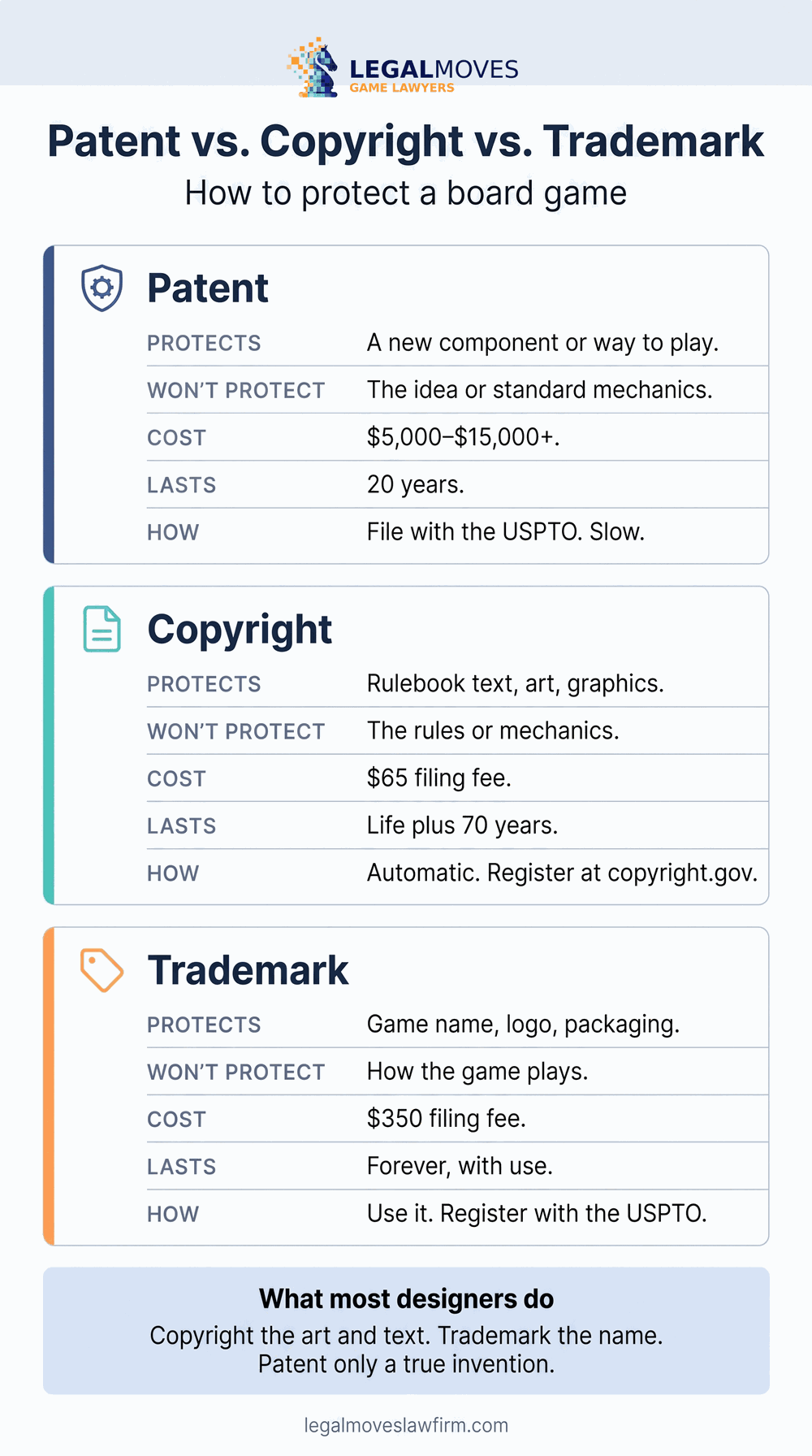
Here is the whole picture in one table.
| Protection | What it covers for a board game | What it does NOT cover | Rough cost | How long it lasts | How you get it |
|---|---|---|---|---|---|
| Patent | A novel component or method of play; the ornamental look (design patent) | The game idea, the rules, or any standard mechanic | $5,000 to $15,000+ | 20 years (utility), 15 years (design) | File and prosecute with the USPTO. Slow. |
| Copyright | Rulebook text, artwork, board graphics, card illustrations, packaging | The rules, mechanics, method of play, or the name | $65 filing fee plus legal fees to register | Life of the author plus 70 years | Automatic when fixed; register at copyright.gov |
| Trademark | The game’s name, logo, slogan, and distinctive trade dress | The gameplay itself | $350 filing fee plus legal fees to register | Potentially forever, with use and renewal | Starts with use (or intent to use); register with the USPTO |
In plain English:
- Your art and your words are copyright.
- Your name and brand are trademark.
- A genuinely new invention is patent.
Notice the overlap nobody warns you about. Not one of these protects your rules or your mechanics. If that worries you, you’re paying attention, and the next sections explain what to do about it.
What a patent actually covers (and why most designers skip it)
You’ve heard “you should patent it” your whole life. For a board game, that advice is usually wrong, and it’s expensive to follow.
There are three flavors you’ll run into.
Utility patent. Protects how something works, like a novel method or mechanism. This is the hard, expensive one, and the only one that could cover gameplay.
Design patent. Protects only the ornamental look of a board or piece. Cheaper, but narrow. It does nothing to stop someone from copying how the game plays.
Provisional patent. Not really a patent at all. It’s a 12-month placeholder that locks in a filing date and lets you say “patent pending.” You have to convert it into a full application within a year, or it evaporates.
Now the reality check. A utility patent commonly runs $5,000 to $15,000 or more once you count office action responses, and it takes 18 months to 3 years to grant. For a typical game built on existing mechanics, it usually gets rejected anyway.
That’s why most designers correctly skip it.
If you do have a genuine invention worth protecting, I go much deeper on patent cost, timelines, office actions, and the software-patent wrinkle in my full guide to game patents. That guide is framed around video games, but the patent rules and the cost tables apply to board games too. It also features an interview with a working patent attorney, which I am not.
Best for: a designer who invented a genuinely new component or method and has a commercial reason to spend five figures getting exclusive rights to it. Skip if: your game is a strong new combination of familiar mechanics, which is most games.
How to copyright a board game
Copyright is the cheapest real protection you will ever buy for your game, and most designers leave it on the table.
The good news first. Copyright is automatic. The moment you fix your work in a tangible form, it’s protected. Your written rulebook, your board art, your card illustrations, and your box design are all covered the second they exist.
Now the catch that trips up everyone. Copyright does not protect your rules, your mechanics, or your method of play. Under federal copyright regulations, “ideas, plans, methods, systems, or devices” are excluded.
In practice, that means a competitor can copy your mechanics as long as they rewrite the rulebook in their own words and use their own art and name. The expression is protected. The system underneath it is not. I unpack that line in more detail in are board games copyrighted.
So why bother registering if protection is automatic? Two reasons that matter.
- You must register before you can sue anyone for infringement.
- If you register on time, you unlock statutory damages and attorney’s fees, which is what makes a lawsuit worth filing.
Here is how to actually do it.
- Identify the protectable works: your rulebook text, board art, and card designs.
- Go to copyright.gov and use the online eCO registration system.
- Pick the right application and pay the filing fee, which is $65 for a standard online registration.
- Upload your deposit copies, like a PDF of the rulebook and your art files.
Register the whole game package, which will include your rulebook and your core art and graphic design. It’s the highest-value legal dollar a board game designer can spend.
Need help? Reach out to us to get started with our flat fee copyright application service.
Trademark: the protection most board game designers actually need
If you only protect one thing, protect your name. It’s the asset that can outlive every patent you’ll never get.
Trademark protects your source identifiers: the game’s name, the logo, a slogan, and distinctive trade dress like a recognizable box or board look. It does not protect gameplay. What it protects is the thing customers actually search for and trust.
Why is it the workhorse? Three reasons.
Protection starts the moment you use the name in commerce. Federal registration with the USPTO adds nationwide rights, a legal presumption that the mark is yours, and public notice to anyone thinking about copying it. And unlike a patent that dies in 20 years, a trademark can last forever, as long as you keep using it and renew it.
Think about the classics. The patents behind Monopoly and Twister expired decades ago. The brands are still worth a fortune, purely on trademark.
The move is simple. Run a clearance search before you commit to a name, so you don’t build a brand on a mark someone already owns. Then federally register the name and logo. I walk through the whole process in how to trademark a board game.
Best for: every designer who plans to sell, full stop. Skip if: you’re making a one-off for your family and will never put it on a shelf.
Note that if you’ve decided on a name but you’re not using it yet, the USPTO offers an “intent to use” basis for your application. This means you can reserve your rights in the name by filing an application and finalizing it later on by showing proof of use in commerce.
Your rights will then date back to the day you filed, giving you a jump on other potential users of the name.
The mistake that can kill your patent rights: public disclosure
If you are chasing a patent, this is the landmine that gets stepped on most. Show your game to the public too early and you can wipe out your rights before you ever file.
The rule cuts two ways. In the United States, you get a one-year grace period after a public disclosure to file your application. In many other countries, you lose foreign patent rights the instant you disclose, with no grace period at all.
And “public disclosure” is broader than people think. Launching a Kickstarter counts. Posting your rules online counts. Demoing at a convention counts. Open playtests without NDAs count.
The fix is boring and effective. File at least a provisional application before you disclose anything. During development, have your playtesters sign NDAs.
A patent attorney friend of mine puts it as “file early and file often.” That advice is gold if a patent is in your plan.
One thing to note: copyright and trademark don’t have this trap. It’s a patent-specific problem.
What most board game designers should actually do
Here’s the bottom line, stripped of lawyer hedging. For roughly 95% of board game designers, the protection plan looks the same.
First, clear and trademark your name. Run a name search, then federally register your game’s name and logo. This is your most valuable and most durable protection, and it’s the one competitors genuinely can’t copy.
Second, register your copyright. Cover your rulebook text and your core artwork. It’s cheap, it’s fast, and it protects what’s most likely to be lifted. Do it.
Third, only chase a patent if you truly invented something new. If you created a novel component or method, and the game is commercially worth five figures and a multi-year wait, then talk to a patent attorney and file before you go public. Otherwise, let it go.
Protecting a board game is real, and it’s usually relatively affordable. It’s just rarely a patent. If you want help building the right IP strategy for your specific game, reach out to the firm and we’ll map it out.
Related questions about protecting a board game
Can you patent a card game? Same rules as a board game. The layout, components, or a genuinely novel method of play can be patented, but a standard card mechanic cannot. Magic: The Gathering is the rare card game with a real method patent.
Is a “poor man’s copyright” real? No. Mailing yourself a copy of your rules does nothing useful. Copyright already exists automatically when you fix the work, and only a real registration at copyright.gov lets you sue.
Can I stop someone from cloning my game? Sometimes. If they copy your art, text, name, or logo, copyright and trademark can stop them. If they only copy your mechanics with their own art and words, usually they’re free to do it. I cover this in what happens when a tabletop game gets cloned.
Want to handle this yourself, without hiring a lawyer?
Speedrun Legal is a 44-lesson course covering contracts, trademarks, copyright, LLCs, and publishing deals — built for indie devs on a budget. Includes a Contract Generator and AI publishing-deal review tool.
Frequently asked questions
How much does it cost to patent a board game?
A provisional patent application usually runs $2,000 to $5,000 with an attorney. A full utility patent commonly costs $5,000 to $15,000 or more once you include office action responses, and a design patent often runs $2,000 to $3,000. The USPTO’s base filing fees are much lower, but attorney work is the bulk of the cost.
Can a board game be patented?
Yes, but only if it includes a genuinely novel and non-obvious component or method of play. You cannot patent the game idea itself or a standard mechanic like roll-and-move or deck-building. Because most board games remix familiar mechanics, the vast majority do not qualify.
How do I make and protect a board game legally?
Register copyright on your rulebook text and artwork, and federally register your game’s name and logo as a trademark. That combination protects what is most likely to be copied, for a few hundred dollars total. A patent is only worth pursuing if you invented something truly new.
Can someone legally copy my board game’s rules?
Often, yes. Game rules and mechanics are treated as methods or systems, which copyright does not protect and a patent usually won’t either. A competitor can copy your mechanics as long as they rewrite the rulebook in their own words and use their own name and artwork.
This article is for educational purposes only and is not legal advice. Reading it does not create an attorney-client relationship. For advice on your specific situation, talk to a qualified attorney.